

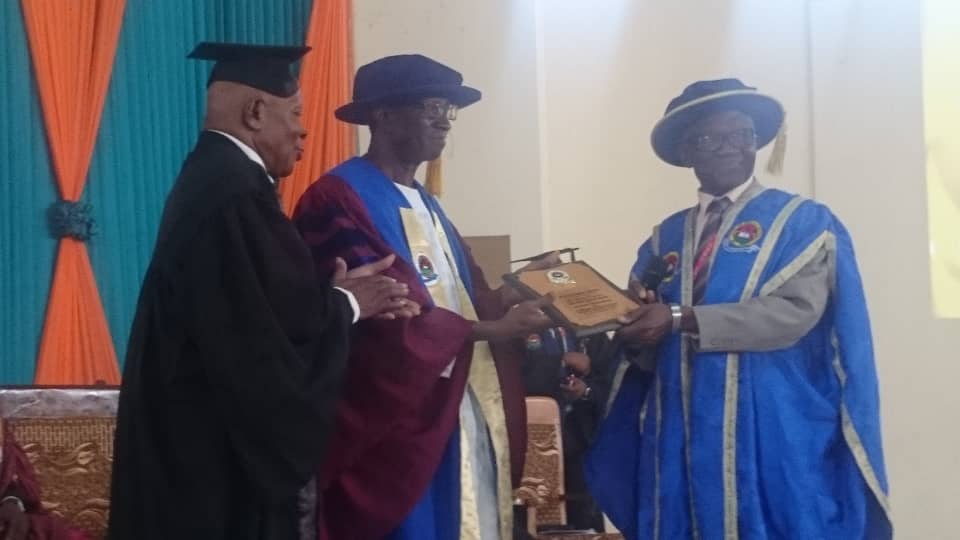
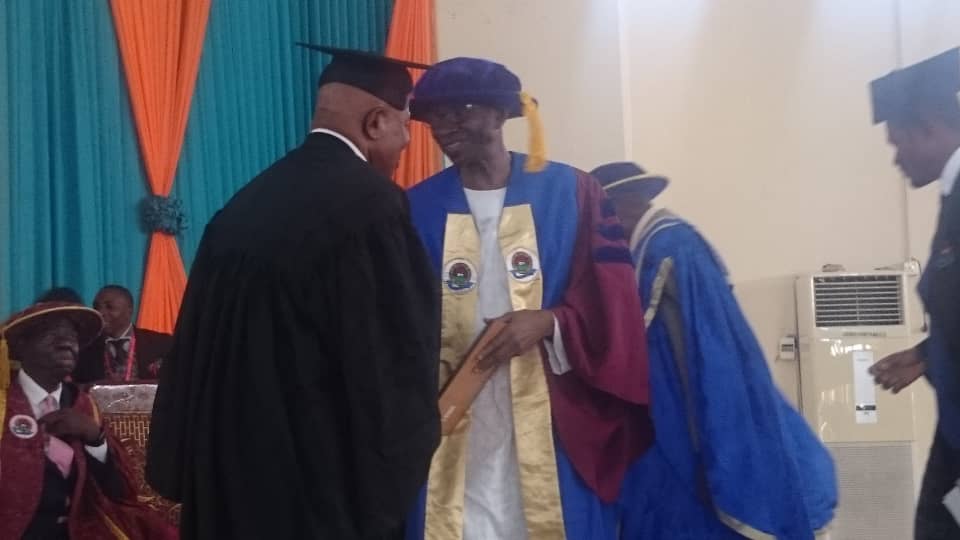
TEXT OF THE 6th ANNUAL MEMORIAL LECTURE DELIVERED BY CHIEF MOSES INAOLAJI ABOABA IN HONOUR OF LATE HRM OBA (DR) OLADELE OLASHORE, CON AT JOSEPH AYO BABALOLA UNIVERSITY, IKEJI ARAKEJI, STATE OF OSUN ON THE TOPIC: NIGERIAN CIVIL SERVICE AND NATION BUILDING ON NOVEMBER 23, 2018.
PROTOCOL
INTRODUCTION
Permit me to quickly thank your great institution for inviting me to deliver the 6th Annual Memorial Lecture in honour of an illustrious Nigerian, a great patriot, a lover of education and human development, the late Oba (Dr) Oladele Olashore CON, the Ajagbusi-Ekun of Iloko-Ijesha.
I congratulate you for instituting the memorial lecture in honour of this friend of ours, the noble Nigerian who contributed immensely to the socio economic advancement of this country in all the places and positions he found himself. His love for education transcends his establishment of Olashore International School at Iloko. It is also evident in your appreciation of the commitment of his resources to help move Joseph Ayo Babalola University forward, as its pioneer Chancellor. That is Oba Olashore for you, one of a kind, a brilliant mind (first and only Banker of the year in Nigeria 1984) (Alpha Communication), a good board player who successfully midwifed the establishment of the then Lead Merchant Bank, among other enterprises, former Secretary of Finance of the Federation (under the brief Sonekan Regime), a rare Oba who transformed his Kingdom (Iloko-Ijesha) to a modern city and more, a patriotic son of Nigeria and Osun state. He was an active participant in the struggle for the creation of our dear Osun State.
Being a friend of Oba Oladele Olasore is so pleasing to me. Being asked to deliver a lecture in his honour is even more pleasing. In his life time, he did his best and we are all very proud of his achievements and legacies.
I am highly impressed by the caliber and quality of the great Nigerians that you had invited to deliver the past five memorial lectures. That also goes to show the nature and character of your University and its determination to let the young generation that you are building here, learn from the wealth of experience of these notable Nigerians and thus stir up their determination and commitment to contribute positively to the development of this nation in the immediate future.
My belief in what Oba Oladele Olashore stood for influenced the choice of the topic of this lecture which is “Nigerian Civil Service and Nation Building”. Indeed, the building and development of our country, as a single entity, holding her own in the committee of developed nations of the world was very uppermost in his mind.
Knowing my stand on the need for Nigeria to have a functional and effective Civil Service, Oba Olashore, in his discussions with me, often lamented the damage done to the Nigerian Civil Service by the Military’s intervention in politics in Nigeria, particularly, the purge and the badly intentioned reforms that had denied the nation the brilliance and efficiency of the post-colonial civil service acknowledged as one of the best in the Commonwealth. The then civil service faithfully and efficiently performed its duties and thus contributed meaningfully to the work of nation building which was proceeding very well, immediately after independence in1960 and up to the end of General Gowon’s rule. Even during the Civil War years, the Civil Service assisted in holding the country united. He agreed that Nigeria cannot progress as desired if this basic Institution of governance and administration, the Civil Service, is not restored its lost glory and given the right atmosphere to co-join the political leaders in building the nation of our dream.
It is gratifying to note that this University is focusing on the production of well-rounded graduates that will be self-reliant, competent and become efficient employers of labour that will add the desired values to our national economy. That is how it should be. However, for your graduates to be fully fulfilled and be able to suitably hold their own in society, we need a Nigeria that is committed to peace, social and infrastructural development. This will only be if we take serious and determined action to let the Nigerian Civil Services have the desired leverage to truly play their assigned roles in the course of nation building.
I consider it apt that this great faith based University is established in remembrance of a great man of God, late Apostle Joseph Ayo Babalola, who was known worldwide for the exploits he did for God in this part of Africa. I observe with considerable excitement that this Institution is established to develop an all-round man that will not only be able to stand on his own but readily contribute to the development of this nation and the world at large. With these opening remarks, let me proceed to the substance of the lecture.
The Civil Service
The Civil Service is the administrative organ through which policies of any government in power are formulated and executed. It is an organization “comprising all servants of the state, other than those holding political appointment, who are employed into the Civil Service established posts in a civil capacity and whose emoluments and other remunerations are paid out of the Consolidated Revenue Fund as approved by the Legislature ---” Encyclopedia Britannica.
What is quickly discernible from this definition is that the Civil Service is an organization established with a mandate to render selfless service to members of the public.
The functions of the Civil Service are:
- To orderly keep the machinery of government running, thus ensuring that it is readily available and useful for the political leadership in the accomplishment of set goals and objectives;
- To offer advice to the political office holders on the efficient deployment of administrative machinery for policy and programme implementation:
- To ensure operational continuity especially during the period of political crisis so that government machinery does not grind to a halt;
- To coordinate and integrate the various activities of government for the purpose of ensuring their consistency with one another and dove-tailing at all levels of governmental administration;
- To faithfully, with clinical efficiency and effectiveness, execute decided and approved policies within a given framework; and
- To provide an effective and unbroken linkage between the government and the governed and to act as a dependable repository of fact, data and deep knowledge so as to ensure relevance of public policy to the well-being of the people, the governed”.
The summary of all these is that the Civil Service serves the three arms of government by giving practical effect to the goals and objectives of government of the day. The fact that cannot, or must not, be lost to any discerning mind is that universally, the Civil Service holds the key to the magnificent door of success or failure of any government. The Civil Service, from the foregoing therefore, is the engine that propels and drives governmental operations and performance: it is the vehicle for efficient service delivery, the tool which any government in power deploys and utilizes to accomplish set goals. It is a policy motivator and initiator.
Undisputedly, therefore, the Civil Service “is one instrument of governance vital to the provision and delivery of quality services to the people. It is the main arena of governmental business: it is the instrument which government uses to regulate and manage all aspects and areas of the society: all other institutions depend on it for approvals and permit which are germane to their (own) operations ………” [Dotun Phillips: Occasional papers No. 3 1990].
Whether in the ancient or in the modern times, the Civil Service is the service of the people. Even when, because of its norms and ethics, it may be distant to the people, the target and ultimate beneficiaries of the end-products of its functions, [i.e. what its function produces] is the people, the governed. It is, therefore, imperative and compelling, in the event that it wishes to have relevance that its workings and operations must reflect the wishes, aspirations and vision of the people, whom it works for. In other words, the operations of the Civil Service must, abidingly, be people-centred and people-oriented. And this it does through the faithful implementation of decided and approved policies and programmes of the government in power at any particular time. What is not in contention here is that the Civil Service is the primary administrative organ of governance.
Nation Building
What is nation building?
Nation building means constructing or structuring a national identity using the powers of the State…. Nation building includes taking necessary initiative to develop the nation through well designed policies and programmes aimed at enhancing the socio-economic and political development of the citizenry. It is not limited to physical construction of projects alone, it also involves ideological stance, determination of fundamental objectives and directive principles of state policy. It involves provision of major infrastructure development to foster social harmony and economic growth.
In the modern era, nation-building refers to the efforts of newly independent nations, notably the nations of Africa but also in the Balkans, to redefine the populace of territories that had been carved out by colonial powers or empires without regard to ethnic, religious, or other boundaries. These reformed states/nations would then become viable and coherent national entities.
Nation-building includes the creation of national paraphernalia such as flags, anthems, national days, national stadia, national airlines, national languages, and national myths. At a deeper level, national identity needs to be deliberately constructed by molding different ethnic groups into a nation, especially since in many newly established states/nations colonial practices of divide and rule had resulted in ethnically heterogeneous populations.
However, many new states/nations were plagued by tribalism; that is, rivalry between ethnic groups within the nation. This sometimes resulted in their near-disintegration, such as the attempt by Biafra to secede from Nigeria in 1967/1970, or the continuing demand of the Somali people in the Ogaden region of Ethiopia for complete independence. In Asia, the division of British India into India and Pakistan was, in part, due to ethnic differences, which might have been aided by other factors like colonial mismanagement of their situation.
Nation building is about people. It involves economic, social and political development and institutions which protect human right and provide for the rule of law. It involves problem solving by the leadership addressing basic issues of development and social integration.
Having clearly explained the two basic concepts contained in the title, that is “Civil Service” and “Nation Building”, it is the objective of this paper to appraise the role of the civil service in Nation building under the following time framework:-
- Pre-independence and immediate post-independence up till July 1975.
- Civil Service from the General Muritala/Obasanjo regime to General Babangida’s regime
- Post-1997 Civil Service era till date
The final section will focus on the Civil Service of my dream that will serve as a virile agent of development.
Pre-Independence and Immediate Post-Independence Civil Service up till July 1975.
Nigeria is a creation of the Constitution. Nigeria grew into an internationally recognised independent nation, in 1960, after a period of colonialism under the British government which spanned about a century, beginning with the formal annexation of Lagos in 1861. Nigeria’s constitutional development history can be divided into two epochs or generations: the colonial or pre-independence epoch –which covers 6 constitutional instruments (1914, 1922, 1946, 1951, 1954 and 1960) and the post-independence constitutional epochs (encompassing 3 instruments - 1963, 1979 and 1999). While each successive pre-independence constitutional instrument was enacted through an order-in-council of the British monarch, their post-independence counterparts were enacted in two ways: an Act of parliament (1963 Constitution) and military decrees (1979 and 1999).
The one ‘Nigeria’ story began in 1914 with the Frederick Lord Lugard Constitution. The 1914 Constitution amalgamated the Colony and Protectorate of Southern Nigeria with the Protectorate of Northern Nigeria under the colonial authority of the British Monarch. The 1951 Sir John Macpherson Constitution formally established a federal system of government for Nigeria for the first time.
The 1954 Lyttleton Constitution, among others, made regional governments independent of the central government in respect of subjects and legislative powers allocated to them. It also established a unicameral legislature for the federal government and each of the three regional governments. In addition, Lagos was taken out of the control of any regional government and made the Federal Capital Territory; regional public services were established for each of the three regions; the judiciary was reorganised so as to establish regional judiciaries while autonomy was granted to the Southern Cameroons which was up till that time part of a larger Nigeria and Northern Cameroons. Specifically, for the first time, Ministers were given specific portfolios. Thus, the Lyttleton Constitution could best be described as the transition instrument towards Nigeria’s independence in 1960 under a federal structure with democratically elected federal and regional legislatures.
Thus, Nigeria as an evolving nation under the British Colonial Rule experimented with series of constitution. However, the most significant one, which was truly federal and gave opportunity to the Regions to develop at their own pace, was the 1954 Lyttleton constitution.
With the constitution, regional Civil Service, each within each of the Regions – West, East, North and Lagos Colony, each Regional service, under the leadership of and in collaboration with visionary political leaders were actually involved in nation building. The pre and immediate post-independence Civil Service was specifically committed to nation building because of the following factors, among others:
- Right political leadership with commitment to development,
- Political parties with clear manifestoes, which focused on strategies of bringing about socio-economic development.
- Civil Service where officers in the upper echelon were recruited based strictly on merit.
- Civil service based on the norms and ethics of the British tradition (such as anonymity, neutrality etc) and where integrity, accountability and transparency would not be compromised.
- Civil Services where the employees were reasonably remunerated, where each region paid according to its ability.
- Training (and retraining) was given its rightful position.
- The relationship between the higher civil servants and the political leadership in the policy process was one based on mutual trust, respect and cooperation.
Another major factor which also influenced nation building during this era was the practice of true fiscal federalism whereby the regions were allowed to control a substantial proportion of the revenue emanating therefrom i.e resource control.
In Western Region under the political leadership of Chief Obafemi Awolowo and Chief Simeon Adebo as the Head of Service, the region was a pace setter and its remarkable achievements include.
- introduction of free and universal primary education;
- construction of meaningful infrastructural projects such as roads, hospitals, Western Nigerian Television Service (the first in Africa);
- establishment of functional farm settlements as well as employment and training of young school leavers to man the settlements;
- massive growth and development of cocoa including evolving marketing strategy that enhanced income earnings.
- construction of the cocoa house (then the tallest building in Africa).
- establishment of housing and industrial estates in Ibadan and Ikeja.
- establishment of technical colleges,
- establishment of Pilgrims Welfare Boards, etc.
- establishment of the University of Ife, Ile-Ife (now known as OAU)
Good efforts were also recorded in Northern Region which resulted in the then popular groundnut pyramid. Similar efforts were also recorded in Eastern Region notable among which is massive growth of oil palm and production of palm oil for export and domestic consumption. Indeed, Malaysia which became the world largest palm oil producer took its oil palm seedlings from Nigeria.
The builders of the then Civil Service were the top political leaders of Post-Colonial Era who admirably joined efforts with the high echelon of the civil service at the Centre and the regions to face the job of building an independent Nigeria. It was the partnership between Obafemi Awolowo (Premier) and Simeon Adebo (Head of Service) that created and nurtured the Western Nigeria Civil Service that was then adjudged one of the best in the Commonwealth.
In all these developmental strategies, the focus was on man as a centre of development. It was, indeed, an era of “Life More Abundant” for the people.
In his book “Nigeria: Africa’s Failed Asset?”, Sir Olaniwun Ajayi described the good performance of the governments in Nigeria as follows:
“AT INDEPENDENCE, NIGERIA would appear to have given a promise of a nation to reckon with. There was growing civilian democracy, with a good measure of good public administration. The Civil Service tool hold, and held its rightful place attracting the best of the nation’s brains. In education, Ahmadu Bello University came up in the Northern Region; in the Eastern Region University of Nigeria, Nsukka was establised; and University of Ife was set up in the Western Region. Progress and development were also taking place in healthcare delivery. Enrolments in primary and secondary schools were rising. Indeed the Western Region stood out in its meteoric rise. The young but progressive leadership was in hurry. Lee Kuan Yew brought a lot of development to his country Singapore. Thus Liberty Stadium was built in Ibadan, Western Nigeria, t
he first of its kind in Africa South of the Sahara. Industrial and residential estates in Ibadan and Ikeja were established. First Television Station in Black Africa was introduced. The Ife Six-Year Primary Project, Education in Mother Tongue, came into being. Farm Settlements were opened up. Technical Schools for Electrical Installation, Furniture and Masonry, were established. Good Roads were built. Development in Agriculture for Food Crops and Cash Crops was on the rise. Free Primary Education, Free Medical Care and full employment were successfully introduced and financed. Commerce and industries were booming in the new but well planned industrial layout in the Ikeja area of western Region.
Internationally, Nigeria occupied a position of power and prestige with Nigerian Army performing very well as a peace-keeping force in countries such as the Congo and so on. The wealth of the country was booming”.
The successful efforts at nation building in Nigeria just after Independence were possible because of the harmonious relationship and the commonly held nationalistic spirit of the ruling elite and the higher echelon of the Civil Service.
ACHIEVEMENTS OF POST-COLONIAL CIVIL SERVICE
Before the military era, the Civil Service of Nigeria was variously described in glowing terms. Chief Awolowo, in his Autobiography 1960, p.293 stated “Our civil service is exceedingly efficient, absolutely incorruptible in its upper stratum, and utterly devoted and unstinting in the discharge of its many various duties. For our civil servants, government workers and labourers to bear, uncomplainingly and without breaking down, the heavy and multifarious burdens with which we have in the interest of the public saddled them, is an epic of loyalty and devotion, of physical and mental endurance and of a sense of mission, on their part. From the bottom of my heart, I salute all of them”.This is Chief Awolowo’s description of the Civil Service of Western Region headed by Chief Simeon Adebo. Let me say that the description aptly suits the civil service of Osun State which displayed extreme doggedness and high efficiency at the state’s creation out of the old Oyo State in 1991. Nigeria opinion (a University of Ibadan based Public Affairs Magazine) vol.1. No 8 1965 Editorial described Nigeria Civil Services as “Civil Services that are for the most part recruited on merit, that are geared to efficiency standards, and that are largely untouched by crude politics”. D.J Murray in (Journal of Common Wealth Political Studies (1970) described the Service as …”one with a spirit of unity and pride in its work, one of the best in the Commonwealth”.
Mr. C.O. Lawson, a one-time Head of the Civil Service of the Federation in his contribution on the “Role of Civil Servants” in the Quarterly Journal of Administration Vol viii, No2, P.137 asserted that the Permanent Secretaries and top Civil Servants are academically and professionally well qualified to suitably perform their responsibilities. C.O. Lawson described the Civil Servant of his time as the greatest innovator of political, economic and social change. He attributed the following changes which were highpoints of Gowon’s era to the positive contribution of Civil Servants, among others:
- creation of 12 states structure of administration.
- the civil servants ensured the successful implementation of the post-war massive rehabilitation, reconstruction and the reconciliation policy of the Federal Government.
-
civil servants played major role in initiating and implementing the successful programmes and policies of the Federal Governments i.e.
- establishment of posted price for Nigeria’s crude oil.
- promulgation of company decree in 1968 which compelled all companies operating in Nigeria to be incorporated in the country.
- establishment of the National Insurance Corporation in 1969 as a major vehicle for harnessing Insurance Funds for development.
- launching of the Second National Development Plan, 1970-74 (1st integrated plan of the Federal and State Governments and Public and Private-Sector. It was a reconstruction, rehabilitation and reconciliation (3Rs) plan, formulated immediately after he Nigerian Civil War, aimed at creating a just and an egalitarian society, and a land full of hope and bright opportunities for all the citizens. It emphasised indigenization of productive enterprises
- establishment of National Oil Corporation in1971.
- promulgation of Nigeria Enterprises Decree in 1972 which provided for transfer of alien business to indigenous ownership as a way of facilitating indigenous control of the economy.
- establishment of the Bank for Commerce and Industry which was to provide funds for enterprises that would facilitate rapid economic development.
- Denial of Nigeria the efficient and patriotic work of post-colonial civil service, so glowingly spoken about by notable Nigerians and very well acknowledge among commonwealth of nations;
- Non-civil servants with little or no knowledge at all of the operations and norms of the civil service were brought into the high echelon of the service, some of them becoming Directors-General/Permanent Secretaries and even Head of Service at the centre. What quality of service do you expect from such people regardless of their proficiency in other disciplines? Most unfortunately, this kind of practice led to regrettable incidence of some of our Permanent Secretaries and even Heads of Service being named as part of those who perpetrated pension fund fraud which runs into billions of naira. Some of them are still answering charges in court.
- Many civil servants no longer focus on good service delivery but rather on guarantying their own future by colluding with their civilian bosses to loot the nation’s resources; otherwise, how do you explain the phenomenon of EFCC charging some of them to court on fraudulent ownership of large estates in the nation’s capital, fleet of exotic cars, unimaginable fat bank accounts or liquid cash in foreign currencies stock- piled at home?
- Neglect of training, motivation and provision of conducive atmosphere for the civil service to perform efficiently and patriotically.
- Most of the reforms initiated at the federal level and in some of the states were half-heartedly implemented or abandoned.
- The structure of the service,
- The staffing,
- Operational modalities and
- Its efficiency and effectiveness.
- Office of the Head of Service which was abolished by Decree 43 of 1988, was fully restored;
- The Accounting Officer status for Heads of Ministerial/Non Ministerial Departments was fully restored;
- Powers of the Civil Service Commission were restored;
- Pooling of Staff was brought back;
- Study leave without pay was restored;
- The nomenclature “Permanent Secretary” as the Administrative head of Ministerial Department was restored;
- Officers in the Personnel, Accounts and Secretarial cadres reverted to their old nomenclature.
He concluded by saying that the Civil Servants played very important role in the process of formulation and implementation of policy programme which laid the foundation for economic take off.
Chief Henry Fajemirokun, a business mogul and then Chairman of Lagos Chambers of Commerce, acknowledging the positive contributions of the then civil servants, commented as follows “…the Country was lucky to have this crop of civil servants for the management of its administration at this particular point in time, I have no doubt in my mind that the outstanding qualities and remarkable achievements of the corps were made possible by the purposeful and dedicated leadership of the Head of Service”(p143 Quarterly Journal of Administration, volume viii, No2 January 1974).
The same measure of positive contributions by the civil servants were recorded, in relative terms, in Western Region, Eastern Region and, indeed, Northern Nigeria. The overall verdict was that the immediate post-independence Civil Services in Nigeria performed creditably.
When the Military with no Knowledge of civil governance replaced the political leaders commencing from January, 1966, the civil service maintained significant aspects of the quality that facilitated its good performance but only through the first decade of military rule in Nigeria. The civil service also ensured continuity of administration during political interregnum
THE ONSLAUGHTS BREAKING THE CAMEL’S BACK
The first deadly blow was inflicted on the civil service by the purge instituted by the military government of Muritala Muhammed/Obasanjo in 1975, based on trumped up charges of “abuse of office”, “decline in productivity”, “divided loyalty “ and “corruption”. Thus, at a stroke, the security of tenure of civil servants, (the cornerstone of a career civil service) disappeared.
Another round of purge of the civil service was carried out by Buhari/ Idiagbon government in 1984/1985 in which many civil servants were retired. Apart from loss of security of tenure, civil service became politicized. The federal character principle introduced by the military in the 1979 Constitution of the Federal Republic of Nigeria, seriously undermined the merit-based recruitment which hitherto promoted traditional norms of the service, such as apolitical, objectivity, neutrality, efficiency etc. At the centre, the Permanent Secretaries were assimilated as political appointees in January 2009 for remuneration purposes. (RMAFC Act 2008). This is also another act of politisation of the civil service which does not augur well for efficiency.
In January 2010, the tenure of Permanent Secretaries and Directors at the centre was limited to maximum of eight years, another blow to civil servants’ security of tenure as it limits career civil service below director level.
These negative developments, Prof. Dipo Adamolekun described in his paper on “Observing civil services in Nigeria” as “Institution destroying”. Subsequent researchers also found that the direct relationship which hitherto existed between the civil service and development in Nigeria in the immediate years following independence was no more.(European Journal of Business and Management vol 6, No 21,2014).
NEGATIVE EFFECTS
The assault by the Military and their civilian collaborators on the civil service generated the following adverse effects.
PUBLIC SERVICE REVIEW INITIATIVES.
During the Military interregnum that spanned over the periods 1966-1979, and 1984-1999, attempts were made at reviewing the public Service. Some of the critical ones include:
(i) Public Service Review 1972-74
The then military government initiated a major public service reform initiative known as-Jerome Udoji (Public Service Review1972-74) to enhance efficiency through the introduction of modern management techniques and improved internal process. The reform unfortunately was not all that successful as the implementation focused more on salary increases than achieving improved productivity and efficiency.
(ii) The Civil Service Reform Phase
This crucial period spanned the years 1988 – 1997. Unlike previous interventions through the institution of series of Salary and Wages Commissions or Committees since the colonial period, the DOTUN PHILLIPS Panel was unique in the sense that it was constituted to review, (apart from salary) almost all the sub-systems of the Service, especially:
In other words, it was not just one of the Salary and Wages Commissions like Provincial Wages Committees of 1937, Bridges Committee 1941, Tudor Davies Commission 1945, Miller Committee 1947, , Morgan and Mbanefo Committee 1959, Elias Commission of 1960 or Morgan, Adebo and Udoji Commissions of 1963, 1971, and 1973 respectively. Government white Paper on Professor Philips report through Decree 43 of 1988, tried to modify almost all critical operational guidelines on establishments to enhance professionalism, promote decentralization and delegation, enhance accountability, checks and balances, promote general modernization, combine responsibility with authority and enhance efficiency, effectiveness and speed of operation.
(iii) Post-Civil Service Reform Era
This era effectively began in 1998. The AYIDA Report and the subsequent Government White Paper on “The Report of the Review Panel on the Civil Service Reforms” as approved by the Federal Government and adopted by the State Governments marked the beginning of another era and a return to a Pre-1988 Civil Service structure.
Some of the direct establishment implications of the changes are:-
RE-CREATING THE CIVIL SERVICE AS A VERITABLE TOOL OF DEVELOPMENT AND NATION BUILDING.
It is an established fact worldwide that no nation can develop beyond the level of the quality of its civil service. It has been stated emphatically that the period between 1950 and 1975 represented the golden era of the civil service at the national and sub-national levels in Nigeria. During this period, the public service commanded respect and dignity from the members of the public.
The nation witnessed sporadic growth in various sectors. The higher civil servants considerably influenced the policy process in addition to their managerial competence. The successive post-General Gowon military administrations actually, by various actions or inactions, destroyed the cherished norms, ethics, value and the traditions of the civil service.
It behooves on our leaders to take necessary steps and ensure the restoration of the lost glory of our civil service, to enable it perform in conjunction with our political leaders, the much needed role of nation building just as is done in serious developing and all developed countries of the world e.g. Singapore, Botswana, U.K, America e.t.c.
We should learn from the government of Botswana whose civil service has been acknowledged by both the political leaders and outside observers as one of the key factors that made it possible for the country to emerge as one of the countries (13) that recorded high growth (seven percent and above) during the second half of the 20th century as observed by the Commission of Growth and Development.
We should also learn from Singapore whose former prime minister (Lee Kua Yew) acknowledged the fact that the country’s civil service contributed significantly to the rise of the country from third world to first (2000). In 2008, the then prime minister asserted that the country’s civil service was critical to the country’s good development performance (Adamolekun 2018).
As can be deduced from above, investments in Nigeria’s future can only be realized with a first-class civil service. Hence, the need for our political leaders to accept this as the golden truth and be committed to it. The service needs to be reformed meaningfully in all ramifications particularly thorough and systematic training (at home and abroad) including acquisition of I.C.T (information and communication technology) knowledge among its rank and file, particularly at the senior officers’ level.
In this wise, government should provide the right institutional and governance environment that allows the civil service to deliver goods and services with integrity, transparency, accountability and in line with their mandates.
The federal and state governments should critically examine those things which made the civil services efficient up to the first decade of the military rule and adopt them suitably to restore to the civil services their lost glory and enable them resume, in conjunction with the political leadership, the much needed role of nation building.
In addition, government should provide an enabling social-economic environment that provides for accelerated, inclusive and sustained economic growth.
Conclusion
The damage done to the Nigeria civil service by the military adversely affected its role in the quest for good efforts at nation building and so the fortune of our country started sliding downwards up to the rather sad position that we find ourselves today. Consequently, nation building and development started to be relegated to the background with attention shifted to self-sustenance, and fraudulent acquisition of wealth by looting our commonwealth. Hence, the deterioration in the state of service delivery to the people and the poor state of our economy despite the enormous human and material resources with which God endowed our Nation. If we truly want to salvage this nation from the present predicament and have it occupy the rightful position in the committee of developed countries in the immediate future, we need to show spartan commitment to repositioning our civil services in Nigeria, as no nation can develop with the vilified, broken and wounded civil service that we now have. It is never too late to resolve and be committed to develop our civil services to first class and make it even the envy of developed nations. It is only by doing so that you and I and particularly the young minds that are being nurtured in this serene and ideal environment will have a nation in which they can suitably hold their own. This is what late Oba Oladele Olashore (your late Chancellor) would desire.
Thank you for listening.
Chief Moses Inaolaji Aboaba
November 23, 2018.